
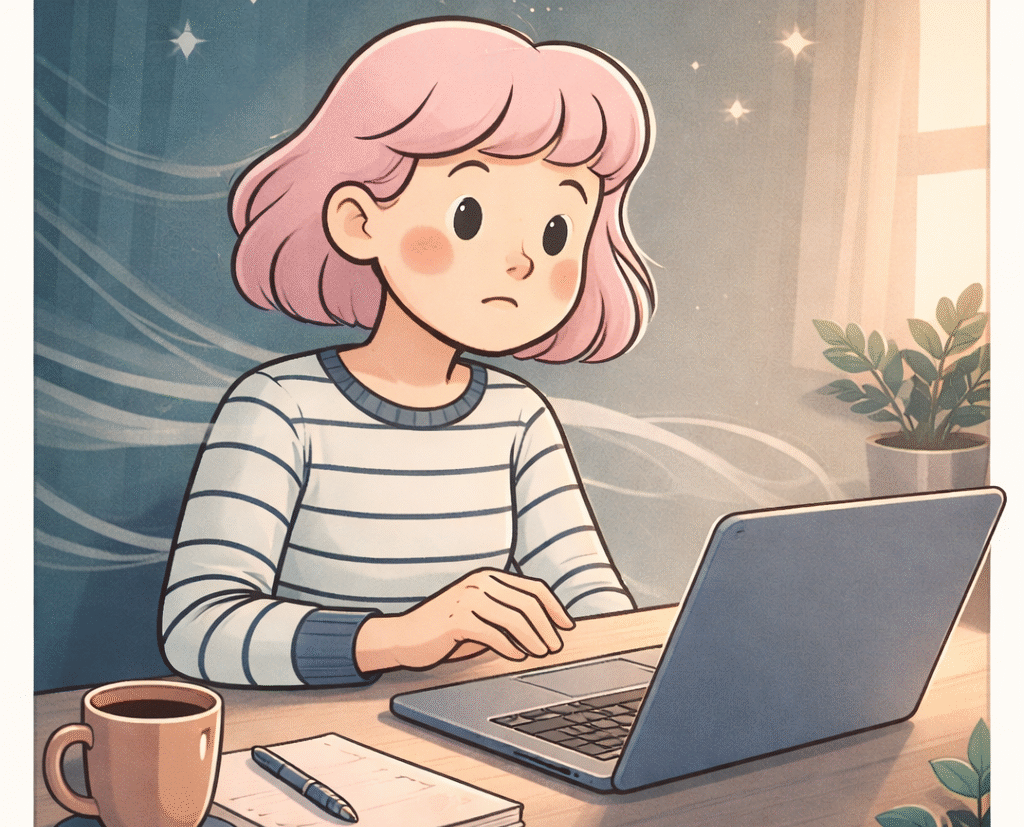
When people think about ADHD, they usually think about distraction or restlessness. But for many adults, the hardest part isn’t visible at all. It’s internal.
Sometimes it’s not about the task itself. It’s that moment when you open your laptop, look at the thing you planned to do… and your body just goes a bit tight. You hesitate for a second, maybe check something else first.
It’s the intensity of emotions.
It’s the fear of getting it wrong.
It’s the pressure to do things perfectly… or not do them at all.
And often, underneath all of that, there’s a quiet fear of being judged.
Why ADHD Feels So Intense
ADHD is not just about attention. It also affects how the brain processes emotions.
The ADHD brain tends to feel things more intensely, get overwhelmed more quickly, and have a harder time stepping back from emotions.
So when a feeling shows up, it doesn’t feel like “this is something I’m experiencing.” It feels like “this is who I am right now.”
That intensity matters, especially in social situations.
Rejection Sensitivity Isn’t “Just Being Sensitive”
You may have heard the term Rejection Sensitive Dysphoria (RSD). It’s not an official diagnosis, but it’s widely recognized in ADHD.
It describes intense emotional pain in response to real or perceived rejection or criticism.
This can look like assuming someone is upset with you, expecting negative feedback, replaying conversations over and over, or feeling deeply hurt by something small.
From the outside, the reaction can seem “too much.” But from the inside, it feels real and often overwhelming.
When rejection feels intense, your brain tries to protect you. And it doesn’t feel like a thought, it feels physical. A small drop in your stomach, a bit of tension in your chest, that quick “ugh” feeling before you even fully know why.
What It Can Look Like in Real Life
You send a message. 20 minutes pass. No reply.
You know, logically, that the person is probably just busy. But your body reacts differently.
There’s a sudden wave: “Did I say something wrong?” “Are they upset with me?” “Maybe they don’t like me anymore.”
And it doesn’t just stay in your thoughts. It feels physical. Heavy. Uncomfortable. Hard to ignore.
This is what RSD can feel like.
Where Anxiety Fits In
ADHD rarely comes alone. Anxiety is very common, and it amplifies everything.
Anxiety’s job is to look for danger. But it often overestimates the problem and underestimates your ability to cope.
So now it’s not just “Did I do something wrong?” It becomes “I probably did something wrong, and I won’t be able to handle it.”
Where Perfectionism Comes In
Perfectionism in ADHD is often misunderstood. It’s not about liking things neat or organized. It’s about safety.
When rejection feels this intense, the brain looks for a way to protect you. And one of the ways it does that is: “If I do it perfectly, I’ll be safe.” “If it’s perfect, no one can criticize me.”
The problem is, perfect doesn’t really exist in real life. So the brain ends up chasing something that’s not actually achievable.
Perfectionism doesn’t always look like high standards. Sometimes it looks like rewriting the first sentence three times. Or opening a message, typing a reply, deleting it… and coming back to it hours later.
It often turns into all or nothing thinking, unrealistic standards, and fear of mistakes.
And eventually: not starting, or starting then getting stuck, or never quite finishing.
Why Starting Feels So Hard
This is where everything connects.
You feel some level of pressure. Anxiety kicks in.
You start thinking about how it could go wrong. Rejection sensitivity activates.
You try to control the outcome. Perfectionism shows up.
You start thinking, “let me just get a bit more clear first,” “maybe I should plan this properly,” “I’ll do it when I have more time.”
You overthink. Your brain gets overloaded.
Now everything feels equally important, equally loud. It’s like having five tabs open in your head at the same time, all asking for attention.
And then you don’t start. Or you start, but get pulled back into the same loop before finishing.
You might find yourself just sitting there, scrolling, getting up for something random, or suddenly feeling tired. Not because you don’t care, but because your system is overloaded.
Why Finishing Feels Just as Hard
Sometimes the hard part isn’t starting. You might actually begin.
Maybe there’s a deadline. Maybe someone is waiting on you. Maybe you finally get a small window of focus.
But somewhere in the middle, something shifts.
You start second-guessing what you’ve done. It suddenly doesn’t feel good enough. You keep tweaking small details. Or you avoid going back to it altogether.
That same pattern shows up again: “What if this isn’t right?” “What if they don’t like it?” “I should fix this before I finish.”
And now the pressure is back.
The closer you get to finishing, the more real the possibility of feedback, judgment, and being seen.
Sometimes finishing means being seen. And that can feel more uncomfortable than not finishing at all.
So your brain tries to protect you. That might look like over-editing, delaying sending, leaving things almost done, or dropping the task entirely.
So it’s not just about starting. Sometimes not finishing is also a form of protection.
The Part That Feels Confusing
Many people say, “I know I’m overreacting… but I can’t stop it.”
That’s because this isn’t just a thinking issue. It’s a nervous system response.
When emotions spike, thinking clearly gets harder, past successes feel out of reach, and tools are harder to access.
Breaking the Cycle (Gently)
This is not about forcing yourself. It’s about working with your brain.
Lower the bar to start. Not “I need to do this properly,” but “I’m just going to begin.”
Move away from perfect. Perfection is trying to keep you safe, but it often keeps you stuck. Ask, “What would 80% done look like?”
Pause before reacting. Even saying “let me think about it and get back to you” creates space.
Talk back to the worry. “I’ve handled things before. I can handle this too.”
Remember what has worked before. Your brain remembers mistakes easily, so you may need to actively remember what went right.
A Different Way to Look at It
If you struggle to start, follow through, or finish, it doesn’t mean something is wrong with you.
It often means your brain is trying to protect you, but using strategies that are no longer helping.
Final Thought
So if you’ve ever found yourself sitting in front of something you want to do, but can’t quite start…
or starting, then getting stuck somewhere in the middle…
or avoiding finishing even when you’re close
it’s not just about focus.
It’s often about what your system is trying to protect you from.
The pressure of getting it right.
The possibility of being seen.
The weight of what it might mean if it doesn’t go well.
Patterns like rejection sensitivity and perfectionism don’t show up randomly.
They’re attempts to keep you safe.
But sometimes, that protection is what keeps you stuck, in the starting, the stopping, and the not finishing.
Nothing has gone wrong here.
Your brain is doing its job, just a bit too well.
And the goal isn’t to get rid of that sensitivity.
It’s to understand it, work with it, and slowly build the capacity to move forward, even when it feels uncomfortable.
Because you don’t need to be perfect to begin.
And you don’t need to be perfect to finish.